At Ascires Hospital Valencia, we have state-of-the-art computed tomography (CT) scanners, which enable us to perform all types of studies, including the most complex ones (all cardiac CT techniques, perfusion studies, dynamic liver studies, etc.).
The advanced technology of our CT scanners in Valencia allows us to perform rapid scans with the highest image definition and the lowest radiation dose for the patient.
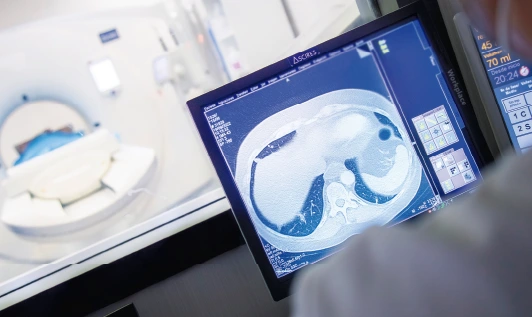
The images obtained from a CT scan provide highly detailed views of the inside of the body, far more precise than those from an X-ray. This allows us to clearly visualise structures such as the brain, heart, lungs, abdomen, blood vessels and more.
Features
What makes our CT scan stand out
Types of CT Scan
Would you like to book an appointment in Valencia? We will assist you by phone: 963 87 30 50
At the Ascires Radiology Service, we perform different types of CT scans:
Contrast administration
In some cases, the administration of contrast is necessary to better distinguish organs and tissues in the body during the scan.
Contrast is a medication administered orally or intravenously, and it will always be requested by a medical professional who deems it necessary, depending on the organ and the condition being examined.
Related services
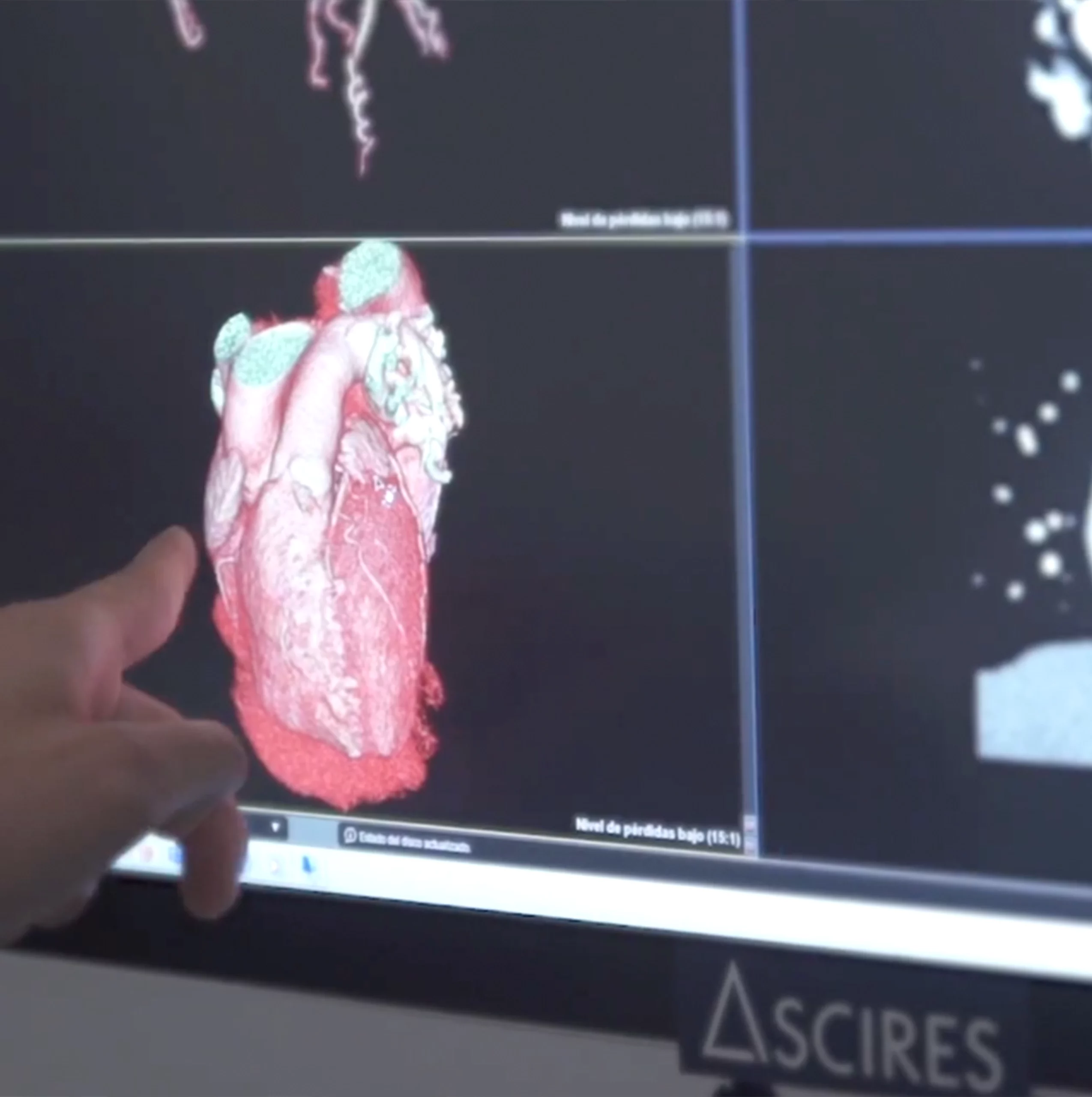
At Ascires Hospital Valencia, we offer a complete catalogue of CT examinations, including all cardiac CT techniques, dynamic liver studies and dual-energy scans for tissue characterisation, among others.

| Name | Address | Phone | |
|---|---|---|---|
| Castelló | |||
| Ascires Castelló | Dirección: Carrer de Betxí, 7, 12004 Castelló de la Plana, Castelló | Teléfono: 961 86 89 98 | Email: moc.sericsa@olletsac |
| Valencia | |||
| Ascires Campanar | Dirección: Radiodiagnóstico: Marqués de San Juan, 6 y 4 Consultas: Avenida Campanar 116 València | Teléfono: 96 340 40 77 | Email: moc.sericsa@ranapmac |
| Ascires Gandia | Dirección: Av. d’Alacant, 123 – Nave 6 46702 – Gandia | Teléfono: 96 186 89 99 | Email: moc.sericsa@aidnag |
| Ascires Sagunto | Dirección: C/ Advocat Fausto Caruana, 11 46520 – Puerto de Sagunto | Teléfono: 96 186 89 91 | Email: moc.sericsa@tnugas |
| Ascires Universitats | Dirección: C/ Menéndez y Pelayo, 25. 46010 Valencia | Teléfono: 963 40 47 90 | Email: moc.sericsa@ytisrevinu |
| Ascires Xàtiva | Dirección: Ronda Séquia de la Vila, s/n, 46800 – Xàtiva | Teléfono: 96 340 43 44 | Email: moc.sericsa@avitax |
A CT scan (Computed Tomography), also known as a CAT scan, is a diagnostic imaging test that allows viewing the inside of the body in highly precise cross-sectional images. It uses X-rays and advanced software to create 3D images of organs, bones, soft tissues or blood vessels.
It is used to detect conditions such as tumours, infections, haemorrhages, fractures, thrombosis or lung problems. Thanks to its speed and reliability, it is one of the most commonly used tests in modern medicine. At our hospital in Valencia, we perform CT scans with or without contrast, depending on the patient’s clinical indications.
A CT scan without contrast provides detailed images of the organs using only X-rays. It is useful for examining bones, lungs, trauma or detecting haemorrhages. In contrast, a CT scan with contrast uses a medical tracer that highlights blood vessels, tissues or potential lesions that might otherwise go unnoticed without this visual enhancement.
Contrast can be administered intravenously, orally or rectally, depending on the study. At our centre in Valencia, we perform both types of CT scans, and the specialist determines which is most appropriate based on the diagnostic goal.
For many CT studies, no prior preparation is required. However, for CT scans with contrast, it is generally recommended to attend fasting (for 4 to 6 hours). In some cases, a recent blood test may be requested to assess kidney function, as the kidneys eliminate the contrast from the body.
It is also important to inform the medical team if the patient has allergies, is taking medications, or has conditions such as asthma, diabetes or kidney failure. The entire preparation process is explained to the patient before the scan to ensure their safety.
CT scans use X-rays, so they do involve radiation exposure, although in controlled doses far below the risk threshold. The most modern equipment is designed to use the minimum dose necessary without compromising image quality. Furthermore, the diagnostic benefits far outweigh the potential risks in most cases
At Ascires Hospital, we use low-dose protocols controlled by specialised radiologists, always prioritising patient safety. If a radiation-free alternative exists (such as an ultrasound or MRI), the doctor will evaluate it on a case-by-case basis.
CT (Computed Tomography) and Magnetic Resonance Imaging (MRI) are two diagnostic imaging tests that allow visualization of the inside of the body, but they work in very different ways. CT uses X-rays to obtain detailed images in a very short time, whereas MRI uses magnetic fields and radio waves without any radiation exposure.
CT scans are faster and are usually used in emergency cases to study the lungs, abdomen, bones or trauma. MRI, on the other hand, is better for analysing soft tissues such as the brain, spinal cord, joints or muscles, although it generally takes longer and can be less comfortable for people with claustrophobia or metal implants.
Both tests are safe and highly accurate, and the choice between them is made by the doctor depending on the type of study required. At our hospital in Valencia, we have advanced technology for both CT and MRI, with personalised care for each patient.
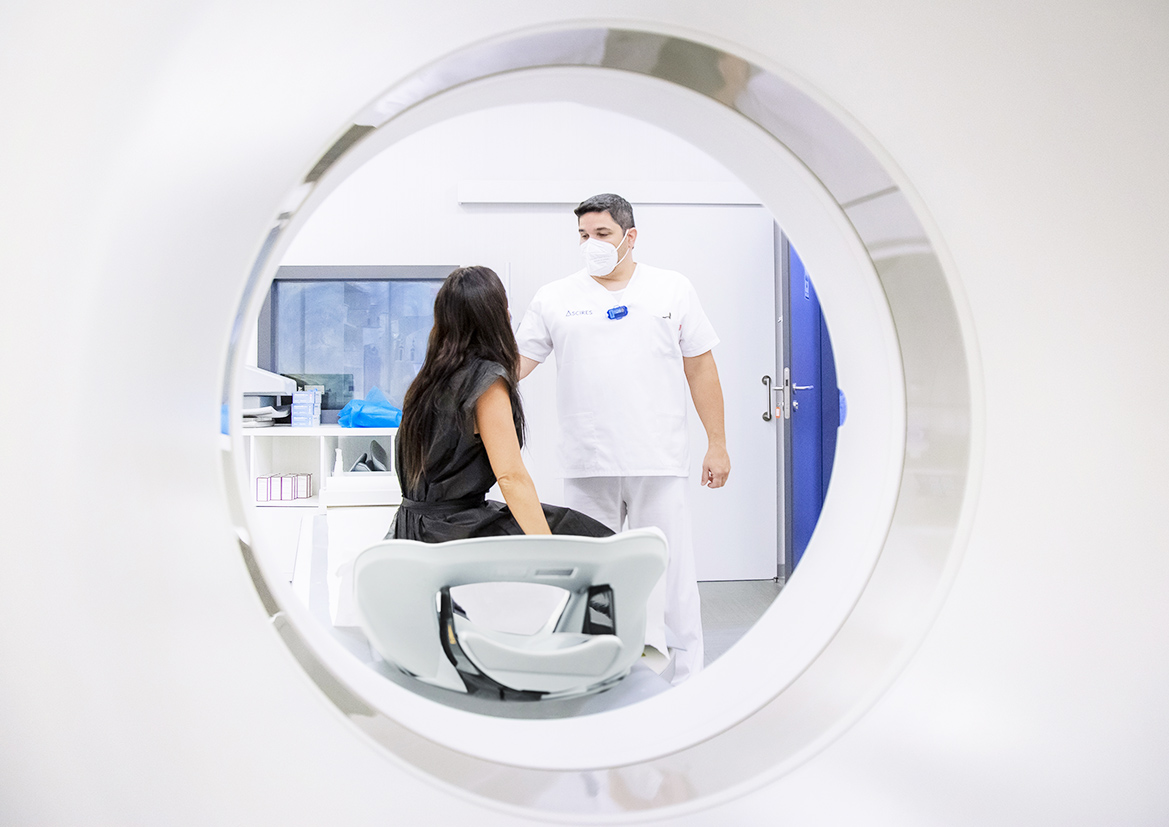
A CT scanner (Computed Tomography) has the shape of a large ring or a short, wide tunnel, similar to a doughnut. In the centre is a circular space through which a table slides, on which the patient lies. As the table moves slowly, the scanner rotates around the body, taking X-ray images from different angles, which are then reconstructed by a computer to create a 3D image of the inside of the body.
It is an open, fast and quiet machine, which does not cause the feeling of confinement that can occur with other tests. The total duration of the study is usually only a few minutes. At our hospital in Valencia, we have state-of-the-art CT scanners that provide high-quality images with minimal radiation exposure, always prioritising patient comfort and safety.
Ascires has the ENS certification with the MEDIA category for its medical centers in the Valencian Community and Madrid.